Vinyl Record Wave Silhouette Bundle
First Impressions: Rhythm, Flow, and That “Just Right” Visual Pulse
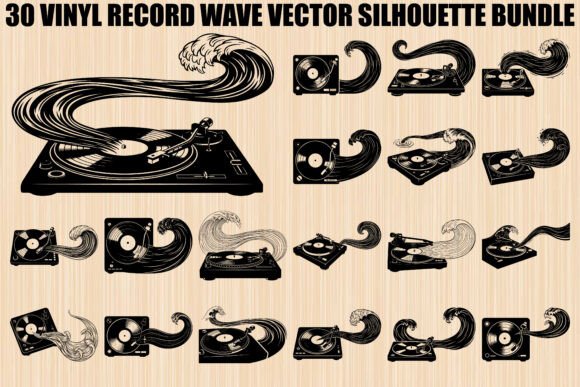
Opening the Vinyl Record Wave Silhouette Bundle felt like flipping to a well-curated track—immediate mood, clear intent, no filler. These aren’t just record icons with wavy edges; they’re thoughtful fusions of analog music culture and organic movement. Each of the 30 silhouettes balances negative space and contour in a way that reads instantly at a glance—critical when you’re stitching for a boutique tote bag or a limited-run sweatshirt line. The wave element isn’t decorative clutter; it’s structural rhythm. It guides the eye, softens hard geometry, and gives breathing room around curves—exactly what saves a design from looking stiff under thread.
A Real Project Test: Embroidering a Limited-Edition Music Lover’s Tote
I pulled one of the mid-size silhouettes (a turntable merging into a gentle crest) for a custom embroidered canvas tote—intended for a local record store’s holiday pop-up. Fabric was medium-weight natural canvas, medium-stretch stabilizer underneath, standard 40-weight polyester thread. What stood out immediately: the clean outer perimeter. No jagged vector artifacts, no unintended micro-loops—just smooth, stitchable outlines. That meant fewer stops to trim threads mid-design and cleaner satin-stitch transitions where the record edge met the wave swell. Customers noticed it too: “It looks *designed*, not just printed,” one said while holding the finished tote. That subtle distinction builds trust in handmade product value.
Where This Bundle Shines—and Where It Asks for Thoughtful Handling
The Vinyl Record Wave Silhouette Bundle excels on stable, flat surfaces: tote bags, tea towels, pillow covers, aprons, and baby onesies (for non-rough-play items). On sweatshirts? Yes—but choose silhouettes with slightly bolder wave contours. Fine-line waves can disappear in fleece pile or dense knit texture. For caps or curved hats? Prioritize the three or four designs with wider base proportions and minimal interior detail—those hold shape better across seams and crowns.
On dark fabric? Excellent contrast potential—especially if you pair deep navy or charcoal with bright teal or warm mustard thread. But test first: some wave details shrink visually on black backgrounds unless stitch density is tuned. On thin or stretchy fabrics (like lightweight rayon tees), use cutaway stabilizer and reduce fill stitch density slightly—those fluid wave forms can distort if over-packed.
This isn’t a bundle for tiny hoop work (<3" diameter) unless you scale carefully. Several designs include subtle interior rhythm lines—great for digital mockups, but they’ll vanish or merge under thread if shrunk below 2.5". For baby embroidery or delicate nursery decor, stick to the five boldest, most open silhouettes. And skip the ultra-detailed corner swirls for high-wash items like kitchen towels—fine lines soften fast.
Design Integrity Meets Commercial Practicality
As an embroidery designer who ships client files and sells finished goods, I care how a design supports professionalism—not just prettiness. The Vinyl Record Wave Silhouette Bundle supports brand consistency because its visual language is cohesive but not repetitive. You can use one silhouette on a patch, another as a small chest logo on a crewneck, and a third blown up as a pillow cover focal point—all feel like part of the same thoughtful collection. That’s rare in illustration bundles.
For Etsy sellers and craft fair vendors, this matters: customers recognize the theme across products without feeling like they’re seeing the same thing everywhere. It reads as curated, not templated. And because the silhouettes avoid text, licensing concerns are simpler—no font rights to navigate, no copyright ambiguity around musical symbols. Just pure, ownable visual metaphor.
Practical Designer Notes Before You Stitch
- Always test on scrap fabric first—especially with textured or dark materials. What reads clearly on screen may need adjusted stitch density or thread color contrast.
- Review stitch density in your embroidery software. Some wave crests read beautifully as fill stitch; others translate more cleanly as running stitch outlines—let the fabric and end use guide that call.
- Confirm hoop size compatibility. While these are vector-based Graphics, your machine’s file conversion step will impact how corners and curves render—don’t assume auto-digitized versions behave identically to hand-digitized ones.
- Inspect small details at 100% zoom: look for anchor points near tight curves, check for stray nodes, and verify that interior negative space (like the center label of a record) is fully enclosed—critical for clean applique design execution.
- Test black-and-white mockups before finalizing listings. Does the silhouette retain its character without color cues? It should—and this bundle does.
- Use proper stabilizer—medium cutaway for knits, tear-away for stable wovens, and always match stabilizer weight to fabric drape.
- Verify licensing terms before selling finished embroidered items or bundling the digital embroidery file into kits. Since this is categorized as Illustrations and Graphics, commercial use permissions vary by seller—check before scaling your craft business.
Final Thought: A Design That Works as Hard as You Do
This isn’t background décor. The Vinyl Record Wave Silhouette Bundle carries intention—from the curve of a wave echoing the groove of a vinyl record to the balance between mechanical precision and natural flow. It fits real projects: a gift for a DJ friend stitched onto a denim jacket, a shop-branded apron for a coffee-and-vinyl café, a personalized baby blanket for a music teacher’s newborn. It earns its place not because it’s trendy, but because it stitches cleanly, scales thoughtfully, and resonates emotionally—without shouting. For embroidery designers, Etsy sellers, and makers building something meaningful, that quiet reliability is the highest compliment a design asset can earn.