Silhouette Jewelry Organizer with Tree
A Clean, Calm Anchor for Thoughtful Embroidery Projects
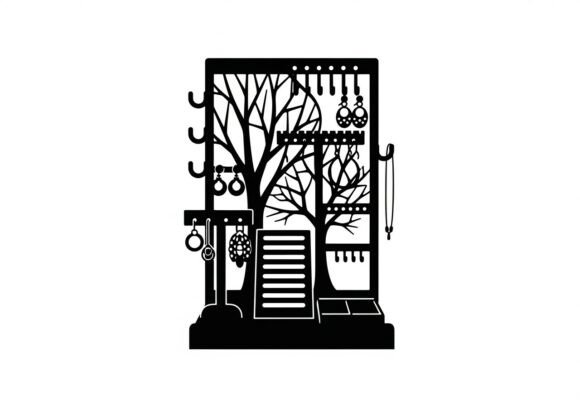
First glance at the Silhouette Jewelry Organizer with Tree tells me this isn’t a busy, trend-chasing graphic—it’s a quiet, intentional shape. The black tree form with its branching hooks feels grounded and graceful, not fussy. There’s no clutter: just clean negative space, balanced proportions, and a subtle suggestion of function—hooks for earrings, a central curve that implies a pendant resting place. It reads as decorative storage, yes, but more importantly, it reads as *intentional curation*. That mood matters deeply when you’re stitching something meant to be seen daily—on a linen tea towel in a boutique kitchen, or stitched onto a baby’s organic cotton onesie as a keepsake gift.
Where It Shines: Real Projects, Real Stitching
I recently tested the Silhouette Jewelry Organizer with Tree as a focal point on a heavyweight natural canvas tote for a local jewelry maker’s holiday collection. It worked beautifully—not as a literal organizer, but as a symbolic, elegant signature. On that fabric, the clean lines held up under medium-density fill stitch, and the open branches gave breathing room between satin-stitched hook details. It also translated well to an embroidered patch sewn onto a denim apron for a craft fair stall: customers responded to its quiet sophistication, especially next to busier floral or script-based designs.
It’s equally effective on softer applications: think sweatshirt embroidery for a small studio’s “organized creativity” merch line, or as a subtle chest motif on a linen pillow cover for nursery decor. Because it’s rooted in silhouette language—not intricate line art or tiny text—it avoids the legibility pitfalls common in baby embroidery or holiday embroidery on textured fleece. As a digital embroidery file, it scales cleanly across hoop sizes without losing structural integrity, making it reliable for both small-batch custom apparel and consistent boutique branding.
Where to Pause—and Plan Ahead
This design isn’t magic on every surface. On highly textured fabrics like bouclé or thick terry cloth, fine hook details can blur; I’d simplify or slightly bold those elements before stitching. On stretchy knits (think ribbed baby caps or fitted tees), stabilization is non-negotiable—use cutaway + topping, and consider reducing stitch density in the trunk area to prevent puckering. And while the white background in the original illustration suggests versatility, remember: on dark fabric, the absence of interior detail means contrast relies entirely on thread color choice. Test black thread on navy twill, then try ecru on charcoal—don’t assume one works universally.
Curved surfaces—like structured caps or curved pillow edges—require careful placement. The base of the tree needs a stable, flat anchor point. Avoid placing it too high on a cap crown or too close to a seam on a tote handle. Also, skip using it as a standalone small hoop design under 3" unless you’re willing to manually adjust hook spacing—those delicate branch tips shrink fast and risk becoming indistinct.
What It Adds to Your Finished Product—Beyond Aesthetics
The Silhouette Jewelry Organizer with Tree quietly elevates perceived value. It doesn’t shout; it invites pause. That translates directly to customer trust—especially for Etsy sellers and handmade product buyers who associate refined simplicity with care and craftsmanship. When stitched cleanly on a linen kitchen towel, it reads as intentional home styling, not generic clipart. On a personalized gift—say, a monogrammed baby blanket with this tree subtly tucked in the corner—it adds narrative weight: growth, care, safe keeping. That resonance strengthens brand consistency for creative entrepreneurs building a cohesive visual language across products, printable mockups, and digital embroidery files.
Practical Designer Notes Before You Stitch
- Always test first—on scrap fabric matching your final project’s weight and stretch.
- Check thread color contrast carefully: deep charcoal or navy often reads richer than pure black on natural fibers.
- Review stitch density—if the original file uses heavy fill in the trunk, consider lightening it for lightweight or delicate fabrics.
- Confirm hoop size compatibility—this design fits comfortably in 4x4 and larger hoops, but verify exact dimensions before digitizing or purchasing.
- Inspect small details—zoom in on hook ends and branch junctions; ensure they’re digitized with clean jump stitches and no stray nodes.
- Test in black-and-white mockups to assess silhouette strength before committing to color palettes.
- Use appropriate stabilizer: cutaway for knits, tear-away for stable wovens, and fusible + topping for sheer or slippery fabrics.
- Verify licensing—since this falls under Illustrations and Graphics, confirm whether the digital embroidery file permits commercial use for finished products or resale as design assets.
Final Thought: A Design That Earns Its Place
The Silhouette Jewelry Organizer with Tree won’t dominate a crowded craft fair table—but it will hold attention longer than flashier alternatives. It’s the kind of embroidery file that supports your story rather than telling it for you. Whether you’re building a cohesive line of embroidered home goods, designing personalized gifts with quiet meaning, or selecting graphics for your next batch of digital embroidery files, this design earns its place by being thoughtful, adaptable, and visually resolved. It doesn’t ask for attention—it earns respect, stitch by careful stitch.