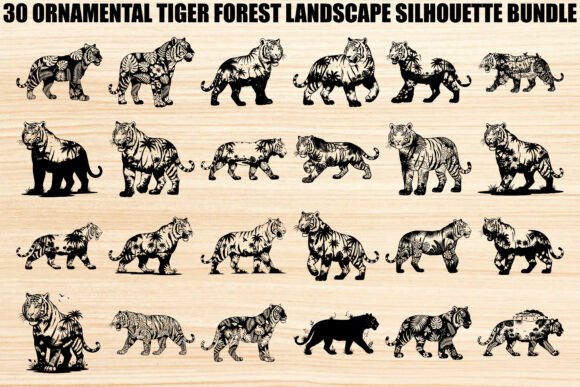
Ornamental Tiger Forest Landscape Bundle
A Designer’s First Look: Bold, Layered, and Unmistakably Wild
Opening the Ornamental Tiger Forest Landscape Bundle feels like unrolling a hand-drawn storybook page—each of the 30 designs centers a tiger silhouette, but not as a simple outline. Instead, the negative space *inside* the tiger is filled with intricate forest scenes: layered palm fronds, winding vines, ferns, and subtle animal silhouettes peeking through. It’s ornamental in the truest sense—not fussy, but intentional. The mood leans into quiet strength and grounded elegance, not aggression or cartoon energy. That makes it ideal for projects where you want sophistication without stiffness: boutique baby blankets, linen aprons for herbalists, minimalist tote bags for eco-conscious shops, or even nursery wall art that grows with the child.
How It Stitches Up: Real-World Embroidery Behavior
I tested one mid-size design (approx. 4.5" wide) on a heavyweight organic cotton tote bag—no appliqué, just direct embroidery using fill stitch and satin stitch for key outlines. The result? Crisp, legible, and surprisingly dimensional. The forest details inside the tiger held up well because they’re built with deliberate spacing—not too dense, not too sparse. That balance matters: too many tiny fill areas would’ve created pilling or thread breakage on textured fabrics; too few would’ve looked hollow. As a machine embroidery design, it breathes. It doesn’t overwhelm the fabric.
This bundle shines brightest on stable, medium-to-heavyweight fabrics: canvas totes, brushed cotton sweatshirts, twill caps, tea towels, and pillow covers. On a soft-loop terrycloth towel, I added light tear-away stabilizer underneath and a light cutaway on top—and the palm fronds stayed sharp. For baby embroidery? Yes—but choose the cleaner, less-dense variants from the set. Avoid the most intricate versions for onesies or swaddles unless you’re stitching on pre-stabilized knit blends and using reduced stitch density.
Where to Use It Thoughtfully—Not Just Everywhere
The Ornamental Tiger Forest Landscape Bundle isn’t a one-size-fits-all embroidery file. Its strength is also its caution point: detail lives *inside* the silhouette. That means:
- Small hoop sizes (< 4"): Some designs exceed comfortable limits. Check individual dimensions before hooping—don’t assume uniform sizing across all 30.
- Stretchy or thin fabrics: Knits, rayon challis, or lightweight voile need extra stabilization and possibly simplified versions. Dense inner fills can distort delicate weaves.
- Curved surfaces (caps, curved pockets): The topmost palm fronds and tiger ears may shift slightly during hooping. Test on scrap first—and consider trimming outer elements if needed for fit.
- Dark fabric backgrounds: The forest layers rely on tonal contrast. On charcoal or navy, use high-contrast thread colors (ivory, gold, sage) rather than matching tones. A black-on-black version won’t read.
- Frequent-wash items: While the stitch layout avoids overly fragile corners, avoid placing the most detailed tigers on cuffs or waistbands that endure constant friction.
What It Adds to Your Finished Product—Beyond Pretty Stitching
Customers don’t buy stitches—they buy meaning, craft, and intention. This bundle delivers that. When stitched on a linen kitchen towel, the tiger becomes more than decor—it hints at resilience, rootedness, quiet power. That elevates perceived value. Etsy sellers tell me buyers comment on “how thoughtful it feels” versus mass-produced motifs. For small shop products or personalized gifts, that resonance builds trust. It says: *this wasn’t slapped on—it was chosen, considered, and executed with care.*
It also supports brand consistency beautifully. If your craft business leans into nature, mindfulness, or slow-living aesthetics, these designs reinforce that voice without needing custom illustration. And unlike generic floral or geometric graphics, the tiger motif offers gentle recognition—familiar enough to feel welcoming, distinctive enough to stand out in a crowded digital embroidery file marketplace.
Practical Notes Every Embroidery Designer Should Run Through
Before committing this bundle to client work, a holiday batch, or your next Etsy listing, do these six things:
- Test on scrap fabric—same weight and weave as your final product. Watch how inner fronds behave under tension.
- Review stitch density visually, not just numerically. Zoom in on vector previews: are there clusters of tiny fill shapes that might merge when stitched?
- Confirm hoop size compatibility for each design you plan to use. Don’t assume all 30 fit a 5x7 hoop.
- Check thread color contrast in both light and dark mockups. Try grayscale previews—some forest layers disappear without tonal separation.
- Use appropriate stabilizer: medium-weight cutaway for knits, tear-away + light topping for towels, no-show mesh for sheer overlays.
- Verify licensing before selling finished embroidered items or bundling the files digitally. As Illustrations and Graphics, usage rights vary—always double-check what’s permitted for commercial embroidery and resale.
Final Thought: A Design That Earns Its Place
The Ornamental Tiger Forest Landscape Bundle isn’t background noise. It’s a statement piece disguised as a silhouette. It works because it respects the craft—not just as decoration, but as a bridge between maker, material, and meaning. Whether you’re stitching a custom sweatshirt for a wildlife educator, designing a limited-run patch series for a botanical apothecary, or creating heirloom baby embroidery for a boutique client, this bundle gives you substance *and* style. Just remember: let the fabric guide you, test before you commit, and choose the tiger that matches both your project’s purpose—and your own design integrity.