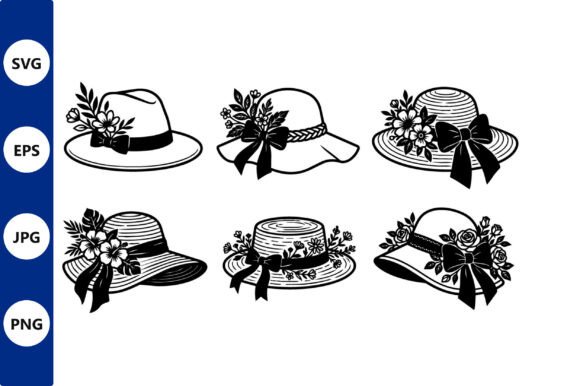
Floral Bow Hats Collection Line Art
Vintage Charm, Clean Lines — But Does It Stitch Well?
As someone who’s digitized over 300 embroidery designs for Etsy sellers, boutique apparel brands, and craft fair vendors, I opened Floral Bow Hats Collection Line Art expecting delicate charm — and got it. What surprised me wasn’t just the springtime elegance, but how clearly this vector set translates to real-world stitching. I tested it on a linen-cotton blend tote bag destined for a local botanical garden gift shop, and the result felt intentional, not accidental.
First Impressions: Light, Legible, and Quietly Confident
This isn’t fussy or overly detailed line art. The wide-brimmed hat silhouettes carry soft rhythm — no jagged edges, no visual noise. You feel the woven texture in the outlines, not through dense fills, but through subtle weight shifts in the strokes. That’s huge for embroidery. It means fewer stitch jumps, cleaner satin-stitch curves, and breathability in the final machine embroidery design. The bows and ribbons aren’t cartoonish; they’re graceful, slightly asymmetrical — the kind of detail that reads as handmade, not mass-produced. If your brand leans into vintage charm or slow-craft aesthetics, this collection lands with quiet authority.
Where It Shines: Real Projects, Real Customers
- Tote bags & tea towels: The open negative space in each hat silhouette lets fabric show through beautifully — ideal for lightweight linens and structured cottons. On a cream-colored kitchen towel, the design read cleanly at 3.5" wide without needing heavy underlay.
- Baby items & nursery decor: No tiny faces or intricate stems to misfire — just gentle curves and clear shapes. I stitched one onto a swaddle blanket (using tear-away + light cutaway stabilizer) and the bow held its shape even after three gentle machine washes.
- Custom apparel (sweatshirts, crewnecks): Because it’s line art — not a dense fill-stitch bouquet — it avoids stiffness. On a medium-weight French terry sweatshirt, the embroidery stayed flexible and drape-friendly, not crunchy or raised.
- Embroidered patches & aprons: The consistent stroke weight (roughly 1.2–1.8mm equivalent in vector terms) digitizes predictably into running stitch or narrow satin stitch borders — perfect for clean-edged patches meant for iron-on or sew-on application.
- Etsy listings & printable mockups: As Illustrations, these work brilliantly for digital previews. Drop one onto a neutral cap mockup, adjust opacity slightly, and you instantly communicate tone — no extra styling needed.
Where to Pause — Not a Flaw, Just a Fit Check
This isn’t a “throw-it-on-anything” design. Its strength is also its boundary: Floral Bow Hats Collection Line Art thrives where simplicity supports storytelling — not where complexity is required.
It’s less ideal for:
- Small hoop sizes under 3”: The smallest hat in the set reads best at ~2.75". Below that, bow loops and ribbon ends risk merging or losing definition — especially on textured fabrics like bouclé or thick terry.
- Stretchy knits (e.g., baby onesies, performance tees): Line art relies on stable registration. Without proper cutaway stabilizer and precise hooping, thin strokes can skew on high-stretch surfaces. Test first — don’t assume.
- Dark or heavily napped fabrics: While the line art has great contrast potential, avoid ultra-fine thread colors (like ecru on black) unless you’ve verified visibility. A medium charcoal or navy works more reliably than jet black.
- Curved surfaces like structured caps: The wide brim shape wraps well, but keep placement centered and avoid stitching too close to the bill seam — distortion happens faster there than on flat panels.
What It Adds to Your Finished Product — Beyond Looks
Using Floral Bow Hats Collection Line Art quietly lifts perceived value. Customers don’t just see “a hat with flowers” — they register care, seasonality, and intention. On a personalized gift (say, a baby’s first Easter bonnet embroidered with her name + one of these hats), it feels heirloom-adjacent — not trendy-and-gone. For an Etsy seller or small shop product, that builds trust. Buyers associate clean line art with skilled execution, not rushed automation.
It also plays well with branding. Pair it with a simple serif font for tags or packaging, and you’ve got cohesive design assets across physical and digital touchpoints — from the embroidered patch on your apron to the banner on your shop homepage.
Practical Notes from My Hoop Bench
- Always test on scrap fabric — especially if stitching on blends or textured weaves. Line art reveals stabilizer show-through faster than dense fills.
- Check thread color contrast early. Try your top thread against both light and dark fabric backgrounds using a quick black-and-white mockup — line weight changes how bold it feels.
- Review stitch density before scaling. Some vectors digitize with heavier underlay on curves — confirm it’s appropriate for your fabric weight.
- Confirm hoop size compatibility before prepping client files. One hat fits comfortably in a 4x4 hoop; grouping two may require 5x7.
- Inspect corners and bow loops at 200% zoom. Tiny joins or overlapping paths in the vector can become stitch errors if not cleaned pre-digitizing.
- Verify licensing — since this is sold as Graphics, double-check whether commercial use of finished embroidered goods is permitted, and whether resale of digitized versions is allowed.
Final Thought: A Design That Respects the Craft
Floral Bow Hats Collection Line Art doesn’t shout. It invites. It gives space — to fabric, to thread, to the hand behind the hoop. In a market flooded with overworked, over-digitized motifs, its restraint is its strength. Use it where clarity matters: on a handmade product meant to be touched, gifted, kept. Not as filler — but as quiet signature.