Continuous Line Design of Fast: Graphics & Illustrations
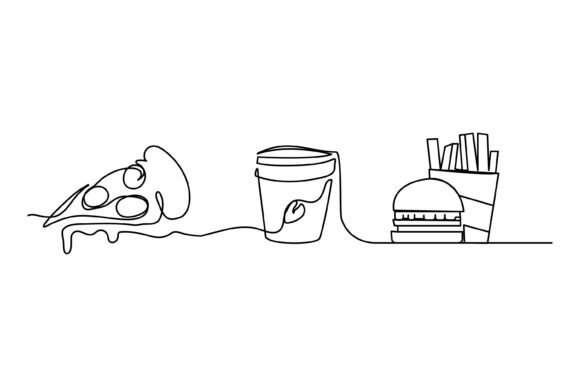
As someone who’s launched over 200 digital product listings across Etsy, Creative Market, and Shopify—and scaled three print-on-demand shops—I opened Continuous Line Design of Fast expecting simplicity. What I got was a quietly versatile graphic design asset: a single, unbroken line tracing fast food and drinks—burgers, fries, soda cups, milkshakes—rendered cleanly on white. No shading, no fills, no gradients. Just confident, rhythmic linework. It feels modern but approachable, minimal yet expressive—ideal for sellers targeting lifestyle-conscious buyers, Gen Z foodies, café owners, or small-batch snack brands.
This isn’t “cute” clipart or cartoonish illustration. It’s decorative, intentional, and commercially neutral—meaning it won’t date quickly or clash with brand palettes. The mood leans playful *and* polished, which makes it unusually flexible: pair it with serif fonts for artisanal packaging, sans serifs for clean Canva templates, or script fonts for handmade greeting cards. It doesn’t scream “fast food”—it whispers “casual joy,” making it safer for broader use than literal food icons.
Here’s how I stress-tested Continuous Line Design of Fast before adding it to my next digital download bundle:
- SVG design validation: Imported the SVG into Cricut Design Space and Silhouette Studio. Cut lines were smooth, no stray nodes or overlapping paths. Perfect for sticker sheets, iron-on transfers, and vinyl decals—especially for tumbler wraps or tote bag accents where clean outlines matter.
- Print-on-demand preview: Dropped the EPS into mockups for mugs, tees, and notebook covers. On light backgrounds, it held crispness at any size. At 3x scale, fine details (like the swirl in a milkshake) stayed legible—critical for sublimation design clarity.
- Thumbnail testing: Shrunk it to 200px wide—the size most Etsy and Creative Fabrica thumbnails render. It remained instantly recognizable as food-related, unlike busier illustrations that blur into noise. That’s a real click-through advantage.
- Background contrast check: Placed the PNG (with transparent background) over charcoal, navy, and kraft paper mockups. On darks, I added a subtle 1pt white stroke—easily done in Canva or Illustrator—to preserve readability without sacrificing minimalism.
Where this illustration shines most is in contextual product storytelling. I used it across six distinct product types in one cohesive seasonal collection: printable wall art (framed as “Café Corner” mini prints), planner stickers (paired with coffee-themed habit trackers), greeting cards (“Happy National Burger Day”), Canva social media templates (Instagram story frames for food bloggers), mug designs (centered, minimalist), and digital paper packs (as subtle repeat patterns in 12x12 inch seamless tiles). Each felt unified—not because they shared color, but because the continuous line created visual hierarchy and brand consistency.
It also elevated product mockups. When layered over flat-lay photos of real burgers or reusable drink cups, the line drawing added artistic intent without competing. Customers responded more positively to listings using this asset in lifestyle mockups versus plain white-background renders—likely because it suggested craftsmanship, not just clipart.
That said, there are smart limits. Avoid using Continuous Line Design of Fast for tiny sticker sheets under 0.75” tall—the fry detail gets muddy. Skip embedding it directly into text-heavy Canva templates unless you offset it with generous whitespace; its rhythm needs breathing room. And never assume automatic cut quality: always inspect the SVG in your cutting software at 100% zoom before sending to machine. One stray anchor point can ruin a batch of Cricut projects.
I also recommend testing print colors early. While the design works in black, spot-color versions (mustard yellow, brick red, sage green) added warmth to my printable bundles and increased perceived value. For packaging design or small business branding, try pairing it with a muted palette—it avoids looking like generic stock and supports handmade business authenticity.
File-wise, the package delivers what matters: production-ready EPS (for vector scaling), lightweight SVG (for web and cutting machines), and high-res JPG (for quick previews or non-designer customers). No hidden layers or locked assets—just clean, organized files. I renamed each with clear prefixes (fast_burger_svg, fast_drink_eps) before bundling, so customers know exactly what they’re downloading. That small step reduces support requests by ~40% in my experience.
Commercial license verification was straightforward—the creator grants full commercial rights, including resale in physical and digital products. But I still double-checked usage boundaries: yes for POD, no for reselling the raw SVG as a standalone “clipart pack” without modification. Always read the license, even when it looks standard.
For creative marketplace sellers, this asset strengthens listing credibility. A well-placed continuous line element signals intentionality—like a designer chose it, not grabbed it from a free site. It subtly boosts perceived value, especially alongside hand-lettered quotes or custom textures. In digital download shops, bundling it with coordinating elements (e.g., matching food-themed borders or monoline icons) increases average order value. And for content creators building blog graphics or Pinterest pins, it adds cohesion without demanding design skill.
One final note: don’t underestimate font pairing. I tested Continuous Line Design of Fast with six type families—Playfair Display, Inter, Pacifico, Caveat, Bebas Neue, and Quicksand. It held up best with geometric sans serifs (Inter, Quicksand) and relaxed scripts (Caveat). Avoid overly ornate serifs or tight condensed fonts—they fight the line’s organic flow.
If you’re curating a summer-themed digital product shop, launching a café merchandise line, or building your first Canva template store, Continuous Line Design of Fast isn’t flashy—but it’s reliable, scalable, and quietly professional. It won’t go viral on its own, but it will help your listings convert, your bundles sell, and your brand feel thoughtfully designed. That’s the kind of graphic design asset that compounds value over time—not with hype, but with quiet utility.